
12. The heating circuit
The second example is a heating circuit: radiators fed through a shunt valve, with a circulation pump. Every building with water-borne heat has one. It is larger than the thermostat, with about fifteen blocks, and introduces three things that larger processes need:
- a curve that turns one value into another;
- a composite block type for a part that is complete in itself, the shunt group;
- start-up behaviour: what a regulator does in its first seconds.
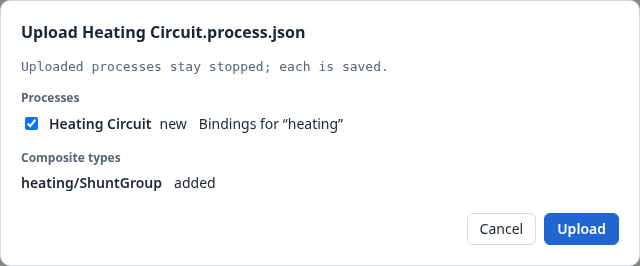
The example is in examples/heating-circuit/. Upload Heating Circuit.process.json with Upload… (Section 9.2) to follow along: it carries the process, its bindings and the composite type it uses.
12.1 The circuit and its I/O

The boiler's water comes in at a temperature of its own. The shunt valve mixes it with the radiators' return, so that the supply water to the radiators has the temperature they need. The colder it is outdoors, the warmer the supply water must be. The circulation pump keeps the water moving through the radiators.
The controller is a Colibri 8 with three modules:
| Channel | Module | Process port |
|---|---|---|
slot1-ai[1] | Pt1000 | outdoor_temperature |
slot1-ai[2] | Pt1000 | supply_temperature |
slot2-aq[1] | AQV, 0–10 V | shunt_valve |
slot3-dq | Relay | pump |
The whole process, running, with every connection watched:
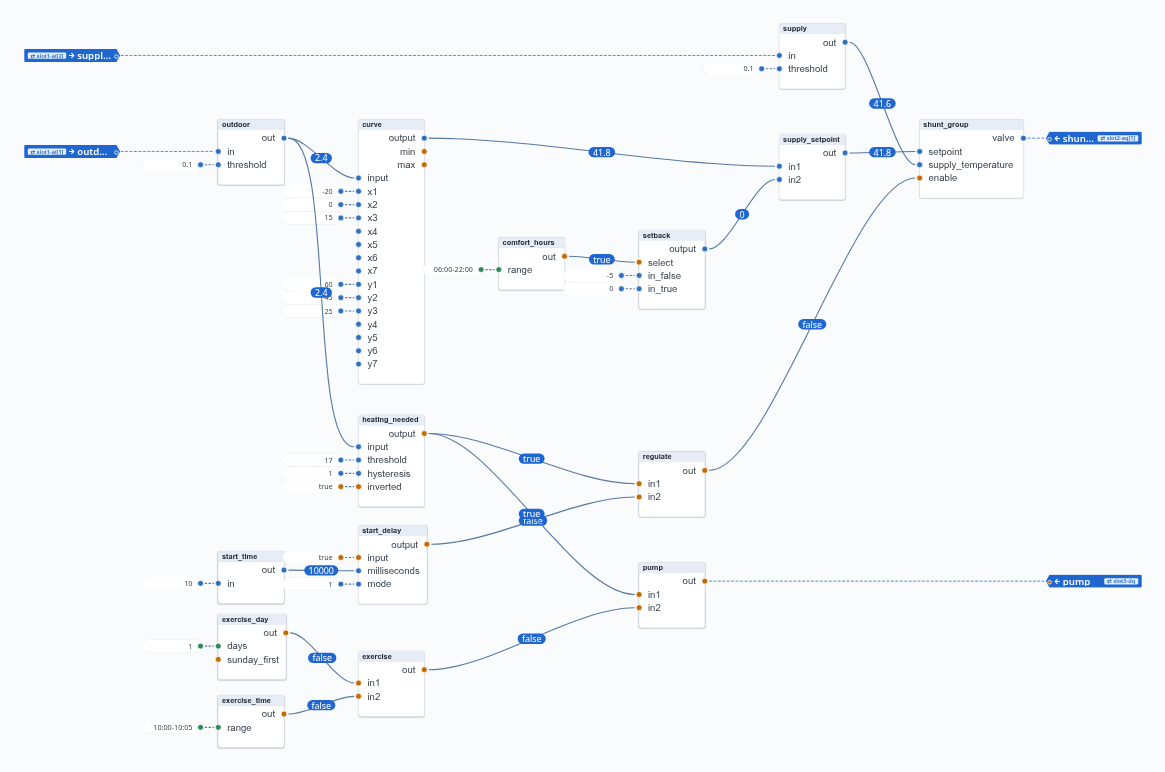
It reads in two bands. At the top, from left to right, is the supply water: its setpoint and its regulation. Below it is when to heat: the summer stop, the start delay, and the pump.
As in the air handling unit, each temperature enters through a process/Deadband of 0.1 °C (outdoor, supply). It filters the sensor's noise. It also gives the value one block to be connected from, since a process input feeds one input, and outdoor is used twice.
12.2 The supply water's setpoint: a curve
The relation between the outdoor temperature and the supply water's is the circuit's heating curve. process/Curve draws it through up to seven points and interpolates in between:
Outdoor (x) | Supply water (y) |
|---|---|
| −20 °C | 60 °C |
| 0 °C | 45 °C |
| +15 °C | 25 °C |
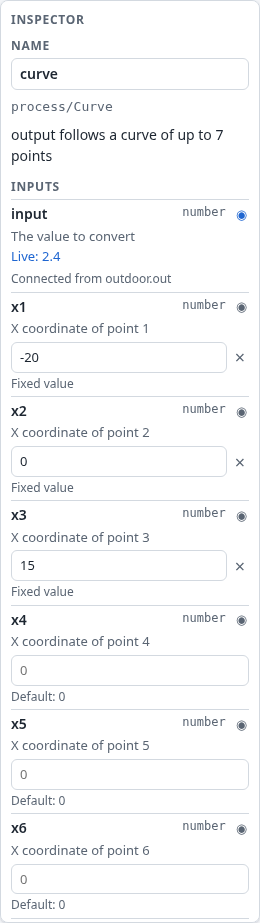
At 2.4 °C outdoors the curve gives 41.8 °C. Outside the points, the curve holds the nearest end: below −20 °C it stays at 60 °C, and its output min is true. Above +15 °C it stays at 25 °C, and max is true.
Unused points drop out by themselves. A point counts only if its x is greater than the previous point's. Points 4 to 7 rest at x = 0, which is not greater than 15, so they are ignored. You add a point by setting its x and y, and remove the last one by clearing its x.
The night setback. Between 22:00 and 06:00 the setpoint is 5 °C lower. comfort_hours (timing/MinuteRange, 06:00-22:00) chooses in setback (process/SelectIn) between 0 and −5 °C, and supply_setpoint (math/Add2) adds that to the curve. The same pattern, a selector followed by an adder, makes any offset that depends on a condition (Section 14.1).
12.3 The shunt group: a composite block type
The shunt group is the regulator that holds the supply water at its setpoint by moving the valve. Every heating circuit in a building has the same one, so it is made a composite block type: heating/ShuntGroup. In the process it is one block, shunt_group, with three inputs and one output:
| Port | What | |
|---|---|---|
setpoint | number in | the supply water's setpoint, °C |
supply_temperature | number in | the supply water's temperature, °C |
enable | bool in | regulate while true, else the valve closed |
valve | number out | the valve's signal, 0–10 V |
Open the type with ↗ in the palette to see inside:
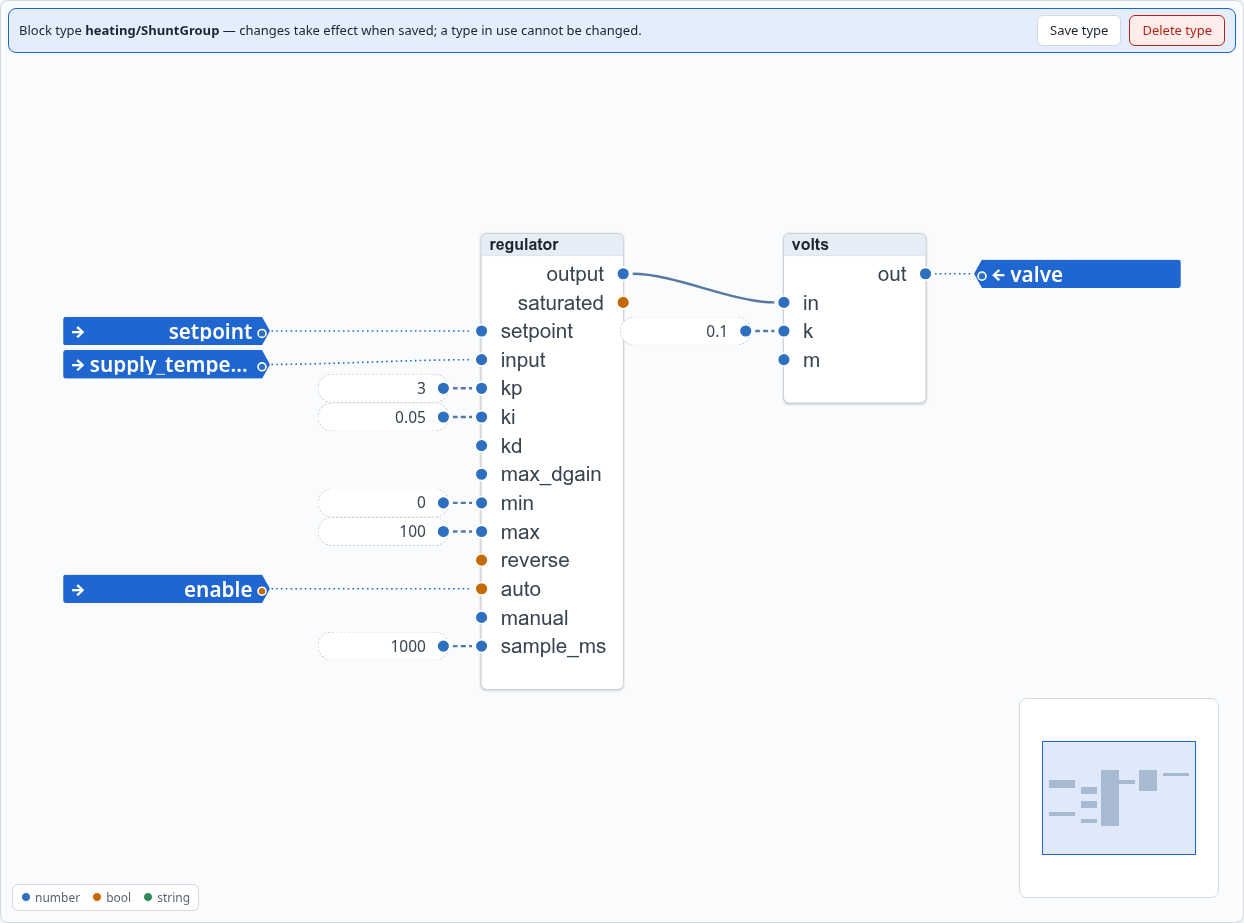
regulatoris aprocess/PID:- Kp 3 %/K and Ki 0.05 %/(K·s), an integral time of 60 s, which suits a shunt;
- output limits 0–100 %;
- a sample every 1000 ms.
Its
autoinput is the type'senable: in manual, the regulator holds itsmanualvalue, which rests at 0 %, so the valve is closed.voltsis aprocess/Linearthat turns percent into volts:out = 0.1 × in, so 0–100 % gives 0–10 V.
The regulator works in percent and the scaling to volts is a block of its own, so the same regulator suits a valve with another signal: change volts.
What the composite type gives you:
- The process reads as what it does.
shunt_groupsays more than a PID and a Linear wired to each other. - One definition. A second heating circuit on the same controller uses another block of the same type, with its own setpoint and sensor.
- Settings in one place. The PID's tuning is part of the type, the same for every block of it. To let each circuit have its own, make
kpandkiports of the type.
Making it yourself. Build the regulator and its scaling as blocks in the process, select them, and choose Create composite type… (Chapter 7). Tick regulator.setpoint, regulator.input, regulator.auto and volts.out, and name them as in the table above.
12.4 Summer stop
When it is warm outdoors there is nothing to heat. heating_needed (process/Hysteresis, threshold 17 °C, hysteresis 1 °C, inverted) is:
- true below 16 °C;
- false above 18 °C;
- unchanged in between.
The band keeps a mild spring day from starting and stopping the pump all day long.
heating_needed decides both whether the shunt group regulates and whether the pump runs.
12.5 Start-up: the start delay
When the process starts, every block computes from its inputs as they are at that moment (Section 6.3). The sensors' first values arrive a moment later, so for that moment supply_temperature reads 0 °C, its resting value.
A PID regulator that goes to automatic in that moment sees an error of 40 °C or more. It switches from manual without a bump: it presets its integral so that its output continues from its manual value, 0 %. The preset is computed from that bogus error, and when the real temperature arrives a moment later, the integral is far off. The valve then stays closed for minutes, until the integral has worked its way back. The air handling unit (Section 13.8) met exactly this.
The cure is to let the regulator go to automatic only once the sensors have delivered:
start_delayis aprocess/Delaywith a fixedtrueon its input andmode1: it delays only the rising edge. In that mode its output starts false, and a true that is there at the start waits the full time.start_time(timing/Seconds) gives it that time, 10 seconds, so it reads as10 → Seconds → start_delay.regulate(logic/And) enables the shunt group when heating is needed and the delay has passed.
Why mode 1? In mode 0, its resting value, a Delay delays both edges and takes its input at once at the start: a fixed true would be passed on immediately. mode 1 is the on-delay, the same block as an alarm delay uses. Section 14.7 collects the start-up patterns.
12.6 The pump and its weekly exercise
The pump runs while heating is needed. A pump that stands still all summer can seize, so it also runs every Monday from 10:00 to 10:05:
exercise_day(timing/DayOfWeek,1) andexercise_time(timing/MinuteRange,10:00-10:05) are joined byexercise(logic/And);pump(logic/Or) isheating_neededorexercise.
During the exercise in summer the valve stays closed, since regulate is false.
Note that the pump has no start delay: it may run at once, and only the regulator must wait for real values.
12.7 Running it against the emulator
Start the emulator with the example's environment examples/heating-circuit/heating.json and hakkas against it (Appendix D). Upload the process, and start it:
- The start. The pump runs at once (it is 2 °C outdoors in the emulator, so heating is needed). The valve stays at 0 V for 10 seconds, then begins to open.
- Regulation. Set the supply water in the emulator's page below the setpoint: the valve opens, gradually, at the pace of the integral. Set it above: the valve closes.
- The curve. Change the outdoor temperature and watch
supply_setpointfollow the curve. - Summer stop. Set the outdoors to 20 °C: the pump stops and the valve closes. At 17 °C nothing changes, and at 15 °C both start again.
The same steps are an automatic test, emulators/colibri/tests/heating-circuit.test.ts. It runs the example in hakkas against the emulator, with the calendar settings adapted to the moment it runs (Section 13.10).
12.8 Exercises
- A second circuit. Add a floor heating circuit to the same process: its own curve (−20 °C → 35 °C, +15 °C → 22 °C), its own sensor, and a second block of
heating/ShuntGroup. - Tuning per circuit. Make
kpandkiports of the shunt group type (open the type, expose them, save it), so that each circuit can have its own tuning. The type is in use, so first remove its blocks, or make the new version under a new name (Section 7.2). - Room compensation. Add a room sensor, and raise the supply water's setpoint by 2 °C for each degree the room is below 21 °C, at most 6 °C: a
math/Subtract, aprocess/Linearand aprocess/Limitbeforesupply_setpoint. - An alarm. Raise a
process/Alarmwhen the supply water stays more than 10 °C below its setpoint for 15 minutes while regulating, for example because the boiler is out.